영향 분석: Google이 A2A 프로토콜을 Linux Foundation에 기부
결론
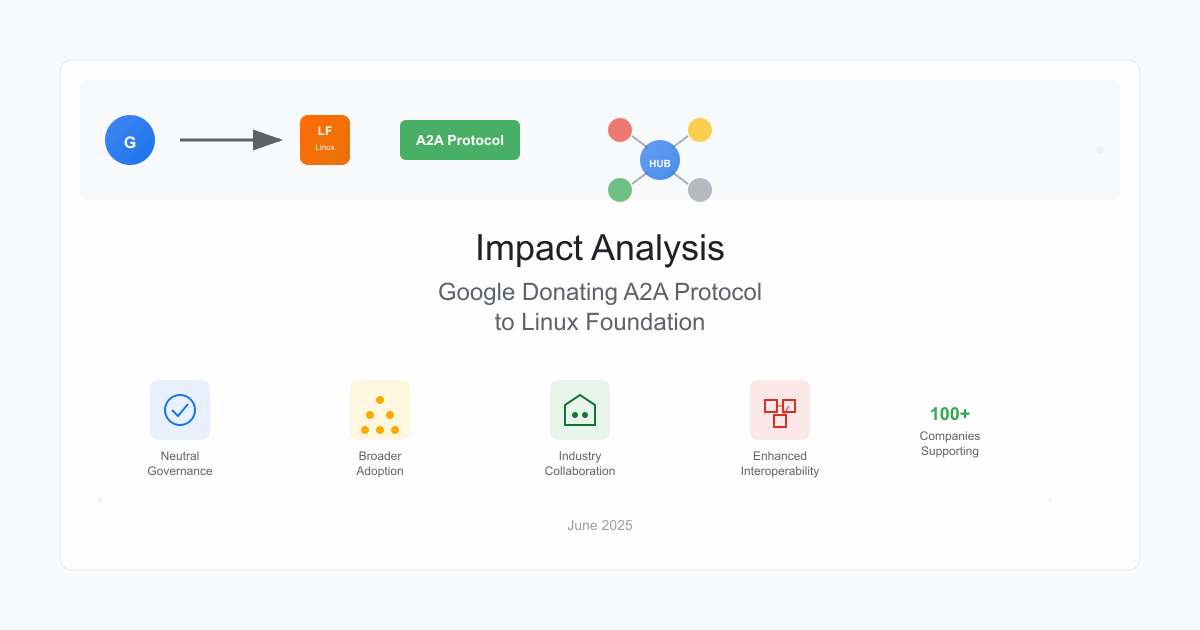
Google의 Agent2Agent (A2A) 프로토콜을 Linux Foundation에 기부하는 것은 프로토콜 개발에 도움이 됩니다. 이러한 움직임은 의사결정 지연과 잠재적 이해 충돌의 위험에도 불구하고 개방형 표준, 산업 협력, 그리고 더 광범위한 채택을 촉진합니다.
배경과 맥락
- A2A 프로토콜: 2025년 4월 Google에서 출시되었으며, AI 에이전트 간의 원활한 통신과 협력을 가능하게 하여 멀티 에이전트 시스템의 상호 운용성 문제를 해결하는 것을 목표로 합니다.
- 기부 이벤트: 2025년 6월 23일, Google은 북미 오픈소스 서밋에서 A2A를 Linux Foundation에 기부하여 중립적 거버넌스를 보장한다고 발표했습니다.
- Linux Foundation: Linux 커널과 같은 오픈소스 프로젝트를 관리하는 비영리 조직으로, 커뮤니티 주도 혁신 촉진에 뛰어납니다.
- 산업 지원: Amazon, Cisco, Microsoft, Salesforce 등을 포함한 100개 이상의 기술 기업의 지원을 받고 있습니다.
잠재적 이점
-
중립적 거버넌스와 표준화
Linux Foundation의 중립적 거버넌스는 A2A가 단일 기업에 의해 통제되지 않도록 보장하여 벤더 종속 위험을 줄이고 산업 표준으로 촉진합니다 (InfoWorld). -
더 광범위한 채택
오픈소스 모델은 더 많은 개발자와 기업의 참여를 유도하며, 100개 이상 기업의 지원은 A2A가 AI 에이전트 통신 표준이 될 잠재력을 나타냅니다 (The New Stack). -
산업 협력과 혁신
Amazon과 Microsoft 같은 거대 기업의 참여는 협력을 촉진하며, @rseroter 같은 X 사용자들은 이를 "AI 협력을 위한 중요한 단계"라고 부릅니다 (X 게시물). Google Cloud 팀도 커뮤니티 주도 개발을 강조합니다 (X 게시물). -
향상된 상호 운용성
A2A는 다양한 AI 프레임워크(LangGraph, CrewAI 등)를 연결하며, Linux Foundation의 지원은 도구와 SDK 개발을 가속화할 수 있습니다 (Medium).
잠재적 도전
-
느린 의사결정
다자간 참여는 복잡한 거버넌스 프로세스로 이어져 업데이트나 기능 개발을 지연시킬 수 있습니다. -
이해 충돌 위험
서로 다른 기업들이 자신들의 우선순위를 추진하여 개발 방향에 대한 의견 불일치를 야기할 수 있습니다. -
불확실한 자원 할당
Linux Foundation은 여러 프로젝트를 관리하며, A2A의 자원 지원은 추가 관찰이 필요합니다.
산업 반응
- X 플랫폼: 사용자 반응은 긍정적이며, @Srikrishna6488은 "미래 지향적"이라고 칭찬하고 (X 게시물), @venky4a는 이를 Linux에서의 Oracle 성공과 비교합니다 (X 답글).
- 뉴스 보도: 주로 긍정적인 리뷰로, SD Times는 A2A가 Anthropic의 MCP를 보완하여 AI 생태계를 향상시킨다고 언급합니다 (SD Times).
요약과 전망
Google의 A2A를 Linux Foundation에 기부하는 것은 프로토콜 개발을 위한 견고한 기반을 제공합니다. 중립적 거버넌스와 산업 지원은 표준화와 혁신을 촉진하며, 100개 이상 기업의 참여는 그 잠재력을 나타냅니다. 의사결정 속도와 이해 충돌 같은 잠재적 도전은 주의가 필요하지만, 현재 증거는 이점이 우세함을 보여줍니다. 미래에 A2A의 성공은 커뮤니티 참여와 재단의 자원 지원에 달려 있을 것입니다.
| 측면 | 세부사항 |
|---|---|
| 기부 배경 | 2025년 6월 23일, Google이 A2A를 Linux Foundation에 기부하여 AI 에이전트 통신 표준을 촉진. |
| 잠재적 이점 | 중립적 거버넌스, 광범위한 채택, 산업 협력, 가속화된 혁신. |
| 잠재적 도전 | 느린 의사결정, 이해 충돌, 불확실한 자원 할당. |
| 산업 반응 | X 사용자와 뉴스 보도 대부분 긍정적, 100개 이상 기업 지원. |
참고문헌
Related Articles
Explore more content related to this topic
A2UI Introduction - Declarative UI Protocol for Agent-Driven Interfaces
Discover A2UI, the declarative UI protocol that enables AI agents to generate rich, interactive user interfaces. Learn how A2UI works, who it's for, how to use it, and see real-world examples from Google Opal, Gemini Enterprise, and Flutter GenUI SDK.
Agent Gateway Protocol (AGP): Practical Tutorial and Specification
Learn the Agent Gateway Protocol (AGP): what it is, problems it solves, core spec (capability announcements, intent payloads, routing and error codes), routing algorithm, and how to run a working simulation.
Integrating A2A Protocol - Intelligent Agent Communication Solution for BeeAI Framework
Using A2A protocol instead of ACP is a better choice for BeeAI, reducing protocol fragmentation and improving ecosystem integration.
A2A vs ACP Protocol Comparison Analysis Report
A2A (Agent2Agent Protocol) and ACP (Agent Communication Protocol) represent two mainstream technical approaches in AI multi-agent system communication: 'cross-platform interoperability' and 'local/edge autonomy' respectively. A2A, with its powerful cross-vendor interconnection capabilities and rich task collaboration mechanisms, has become the preferred choice for cloud-based and distributed multi-agent scenarios; while ACP, with its low-latency, local-first, cloud-independent characteristics, is suitable for privacy-sensitive, bandwidth-constrained, or edge computing environments. Both protocols have their own focus in protocol design, ecosystem construction, and standardization governance, and are expected to further converge in openness in the future. Developers are advised to choose the most suitable protocol stack based on actual business needs.
Building an A2A Currency Agent with LangGraph
This guide provides a detailed explanation of how to build an A2A-compliant agent using LangGraph and the Google Gemini model. We'll walk through the Currency Agent example from the A2A Python SDK, explaining each component, the flow of data, and how the A2A protocol facilitates agent interactions.