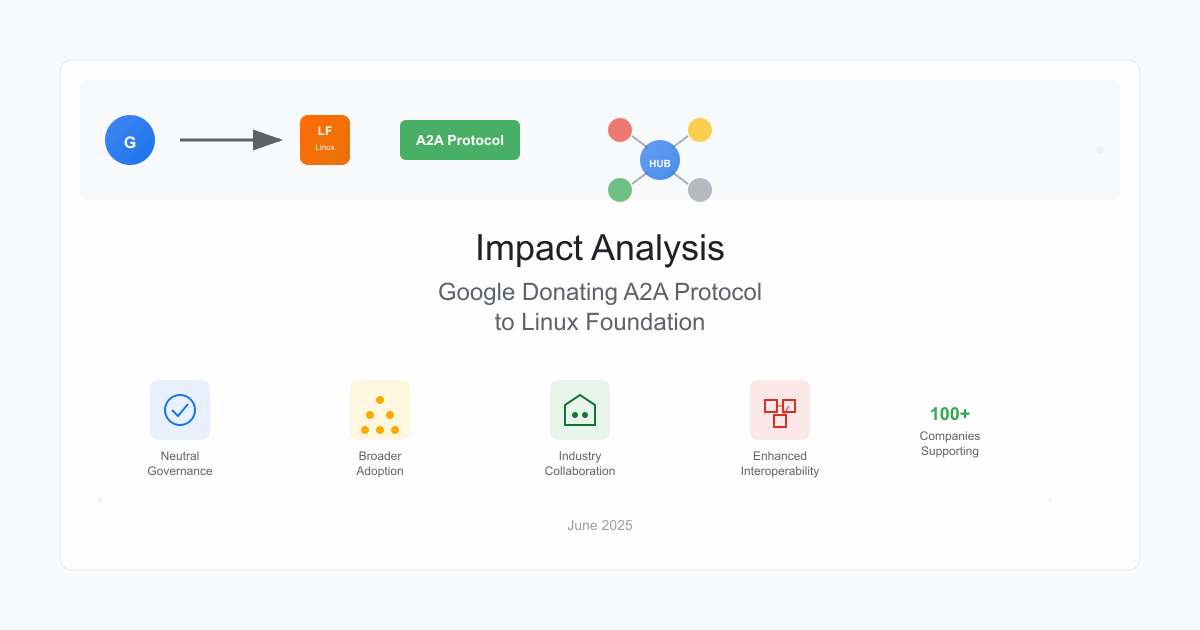
Impact Analysis: Google Donating A2A Protocol to Linux Foundation
Conclusion
Google's donation of the Agent2Agent (A2A) protocol to the Linux Foundation benefits the protocol's development. This move promotes open standards, industry collaboration, and broader adoption, despite risks of slower decision-making and potential conflicts of interest.
Background and Context
- A2A Protocol: Launched by Google in April 2025, aimed at enabling seamless communication and collaboration between AI agents, solving interoperability issues in multi-agent systems.
- Donation Event: On June 23, 2025, Google announced at the North American Open Source Summit that it would donate A2A to the Linux Foundation, ensuring neutral governance.
- Linux Foundation: A non-profit organization that manages open source projects like the Linux kernel, excelling at promoting community-driven innovation.
- Industry Support: Supported by over 100 technology companies, including Amazon, Cisco, Microsoft, Salesforce, and others.
Potential Benefits
-
Neutral Governance and Standardization
The Linux Foundation's neutral governance ensures A2A is not controlled by a single company, reducing vendor lock-in risks and promoting it as an industry standard (InfoWorld). -
Broader Adoption
The open source model attracts more developers and companies to participate, with support from over 100 companies indicating A2A's potential to become the AI agent communication standard (The New Stack). -
Industry Collaboration and Innovation
Participation from giants like Amazon and Microsoft promotes collaboration, with X users like @rseroter calling it "a major step for AI collaboration" (X post). The Google Cloud team also emphasizes community-driven development (X post). -
Enhanced Interoperability
A2A connects different AI frameworks (such as LangGraph, CrewAI), and Linux Foundation support may accelerate tool and SDK development (Medium).
Potential Challenges
-
Slower Decision-Making
Multi-party participation may lead to complex governance processes, delaying updates or feature development. -
Risk of Conflicts of Interest
Different companies may push their own priorities, causing disagreements in development direction. -
Uncertain Resource Allocation
The Linux Foundation manages multiple projects, and A2A's resource support needs further observation.
Industry Reaction
- X Platform: User reactions are positive, with @Srikrishna6488 praising "forward-thinking" (X post), and @venky4a comparing it to Oracle's success on Linux (X reply).
- News Coverage: Mainly positive reviews, with SD Times mentioning that A2A complements Anthropic's MCP, enhancing the AI ecosystem (SD Times).
Summary and Outlook
Google's donation of A2A to the Linux Foundation provides a solid foundation for protocol development. Neutral governance and industry support promote standardization and innovation, with participation from over 100 companies indicating its potential. Potential challenges like decision-making speed and conflicts of interest need attention, but current evidence shows benefits dominate. In the future, A2A's success will depend on community participation and foundation resource support.
| Aspect | Details |
|---|---|
| Donation Background | June 23, 2025, Google donated A2A to Linux Foundation, promoting AI agent communication standards. |
| Potential Benefits | Neutral governance, broad adoption, industry collaboration, accelerated innovation. |
| Potential Challenges | Slower decision-making, conflicts of interest, uncertain resource allocation. |
| Industry Reaction | X users and news reports mostly positive, over 100 companies supporting. |
References
- Google Cloud donates A2A to Linux Foundation
- Google Donates the Agent2Agent Protocol to the Linux Foundation
- Google's Agent2Agent project moves to Linux Foundation
- Google's Agent2Agent protocol finds new home at the Linux Foundation
- Getting Started with Google A2A
- X post by ThomasOrTK
- X post by rseroter
- X post by sarbjeetjohal
- X post by GoogleCloudTech
Related Articles
Explore more content related to this topic
A2UI Introduction - Declarative UI Protocol for Agent-Driven Interfaces
Discover A2UI, the declarative UI protocol that enables AI agents to generate rich, interactive user interfaces. Learn how A2UI works, who it's for, how to use it, and see real-world examples from Google Opal, Gemini Enterprise, and Flutter GenUI SDK.
Agent Gateway Protocol (AGP): Practical Tutorial and Specification
Learn the Agent Gateway Protocol (AGP): what it is, problems it solves, core spec (capability announcements, intent payloads, routing and error codes), routing algorithm, and how to run a working simulation.
Integrating A2A Protocol - Intelligent Agent Communication Solution for BeeAI Framework
Using A2A protocol instead of ACP is a better choice for BeeAI, reducing protocol fragmentation and improving ecosystem integration.
A2A vs ACP Protocol Comparison Analysis Report
A2A (Agent2Agent Protocol) and ACP (Agent Communication Protocol) represent two mainstream technical approaches in AI multi-agent system communication: 'cross-platform interoperability' and 'local/edge autonomy' respectively. A2A, with its powerful cross-vendor interconnection capabilities and rich task collaboration mechanisms, has become the preferred choice for cloud-based and distributed multi-agent scenarios; while ACP, with its low-latency, local-first, cloud-independent characteristics, is suitable for privacy-sensitive, bandwidth-constrained, or edge computing environments. Both protocols have their own focus in protocol design, ecosystem construction, and standardization governance, and are expected to further converge in openness in the future. Developers are advised to choose the most suitable protocol stack based on actual business needs.
Universal Commerce Protocol (UCP): The Complete 2026 Guide to Agentic Commerce Standards
Discover Universal Commerce Protocol (UCP), the open standard revolutionizing agentic commerce. Learn how UCP enables seamless interoperability between AI platforms, businesses, and payment providers, solving fragmented commerce journeys with standardized APIs for checkout, order management, and payment processing.