Introduction
- As AI agent technology rapidly develops, standardizing communication protocols for different scenarios has become a key industry requirement. This report aims to analyze the characteristics of the AG-UI protocol and its relationship with MCP and A2A protocols.
- AG-UI, as an emerging open-source protocol, focuses on solving communication problems between AI agents and frontend applications, forming a complementary relationship with existing MCP (Model Context Protocol) and A2A (Agent2Agent) protocols, collectively building a complete AI agent communication ecosystem.home
Part 1: AG-UI Protocol Overview
-
Definition and Objectives: AG-UI (Agent-User Interaction Protocol) is an open, lightweight, event-based protocol designed to standardize communication between AI agents and frontend applications. As stated in the official documentation, AG-UI "standardizes how front-end applications connect to AI agents through an open protocol," serving as a "universal translator for AI-driven systems."
-
Core Technical Features:
- Real-time interactivity: Supports real-time event streaming, ensuring synchronization between users and agents for a smooth interaction experience
- Human-in-the-loop collaboration: Allows users to intervene in AI decision processes, suitable for complex workflows requiring human confirmation or guidance
- Transport agnosticism: Supports various transport methods such as SSE, WebSockets, and webhooks, adapting to different application scenarios
- Lightweight design: Minimizes dependencies, facilitates integration, suitable for projects of all scales from simple demonstrations to enterprise-level applications
- Standardized events: Defines 16 event types (such as TEXT_MESSAGE_CONTENT, TOOL_CALL_START), simplifying development
-
Working Mechanism: AG-UI implements agent-frontend communication through an event-driven architecture. As described in the Reddit discussion: "The magic happens in 5 simple steps: 1. Your app sends a request to the agent; 2. Then opens a single event stream connection; 3. The agent sends lightweight event packets as it works; 4. Each event flows to the Frontend in real-time; 5. Your app updates instantly with each new development."
Part 2: Comparison of AG-UI with MCP and A2A
-
Functional Positioning:
- MCP (Model Context Protocol): Focuses on connecting AI agents with external data sources and tools (such as GitHub, Notion, etc.)
- A2A (Agent2Agent Protocol): Enables communication and collaboration between different AI agents
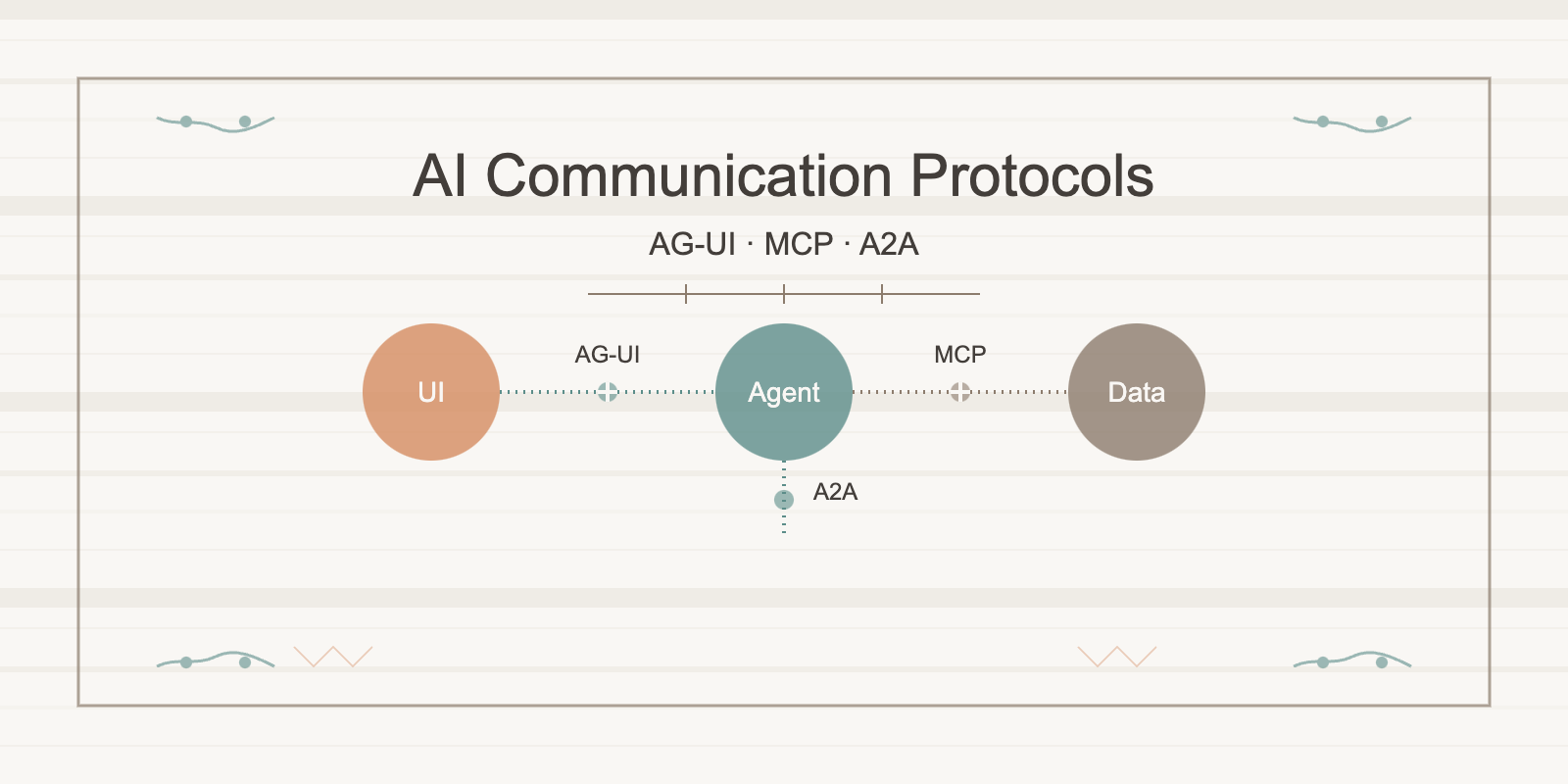
- AG-UI: Connects backend AI agents with frontend user interfaces, enabling real-time interaction
-
Technical Implementation:
- MCP: Utilizes a client-server architecture, providing pre-built integrations, simplifying interactions between AI models and external systems
- A2A: Implemented through JSON-RPC 2.0 over HTTP(S), supporting task delegation, information exchange, and secure collaboration
- AG-UI: Implements real-time communication based on event streams (such as SSE, WebSocket), defining 16 standard event types
-
Application Scenarios:
- MCP: Suitable for scenarios requiring access to external data and tools, such as data retrieval, API calls, etc.
- A2A: Suitable for scenarios where multiple agents need to collaborate on complex tasks, such as task allocation, information sharing, etc.
- AG-UI: Suitable for scenarios requiring real-time user interaction, such as chat interfaces, collaborative editing, etc.
Part 3: Collaborative Relationship Between the Three Protocols
-
Complementary Collaboration: These three protocols are not in competition but form a complementary ecosystem. As stated in the "Zhizhiliu" WeChat article: "AG-UI's development is iterative, first with MCP solving structured communication of modular components, then A2A implementing orchestration between specialized Agents, and AG-UI being the first to clearly connect backend Agents with frontend user interfaces."
-
Complete Communication Chain: The three protocols collectively build a complete AI agent communication chain:
- MCP handles communication between agents and external tools/data
- A2A handles communication between agents
- AG-UI handles communication between agents and user interfaces
-
Practical Application Scenarios: In a customer support scenario, an agent might access customer history through MCP, collaborate with technical support agents through A2A to solve problems, and finally update users in real-time through AG-UI in a chat interface. As @akshay_pachaar emphasized on the X platform, AG-UI "completes the protocol stack."
Part 4: AG-UI Ecosystem and Integration
-
Framework Integration: AG-UI has achieved "out-of-the-box" integration with multiple mainstream AI frameworks, including LangChain, Mastra, CrewAI, and AG2, with more partnerships coming in the future.
-
Developer Tools: AG-UI provides TypeScript and Python SDKs, simplifying the integration process. Developers can quickly build React frontends using CopilotKit components or explore interactive playgrounds through quick start guides.
-
Community Development: AG-UI has established working groups that meet regularly to drive the development and improvement of the protocol. As mentioned in the Hacker News discussion: "We have the first working group this Friday, to help expand and steer the direction of the protocol."
Conclusion
- AG-UI, as an emerging open-source protocol, fills the communication gap between AI agents and frontend applications, forming a complementary relationship with MCP and A2A to collectively build a complete AI agent communication ecosystem.
- The three protocols each have their focus: MCP connects agents with external tools/data, A2A enables inter-agent collaboration, and AG-UI connects agents with user interfaces.
- As AI agent technology continues to evolve, the collaboration of these three protocols will provide developers with a more flexible and efficient AI application development environment, promoting the widespread application of AI agent technology across various industries.
- Developers can quickly get started with AG-UI through official documentation, GitHub repositories, demo applications, and community support resources to build real-time, interactive AI applications.
Related Articles
- Understanding A2A Protocol: A Comprehensive Guide
- A2A Protocol Development Guide(TypeScript)
- A2A vs MCP: The Protocol Revolution in AI Architecture
Goto A2A
Related Articles
Explore more content related to this topic
A2A vs MCP Protocol Relationship: In-Depth Community Discussion Analysis
Comprehensive analysis of A2A vs MCP protocol relationship based on GitHub community discussions. Explores design philosophy differences, ecosystem maturity, and practical guidance for choosing between agent-to-agent communication vs tool standardization approaches.
AgentMaster Multi-Agent Conversational Framework - Multimodal Information Retrieval System Based on A2A and MCP Protocols
AgentMaster is a next-generation multi-agent conversational framework jointly developed by Stanford University and George Mason University, pioneering the integration of A2A and MCP protocols in a single system. It supports multimodal inputs including text, images, and audio, automatically decomposes complex tasks through coordinator agents, and implements various functions such as SQL queries, information retrieval, and image analysis with excellent performance and user-friendliness.
A2A MCP AG2 Intelligent Agent Example
An A2A protocol intelligent agent built with the AG2 framework, integrating MCP protocol and YouTube subtitle processing capabilities.
A2A MCP: Predicting the Winner in AI Protocol Evolution
Comprehensive comparative analysis of A2A MCP protocols. Deep dive into A2A MCP technical architecture, implementation approaches, and ecosystem advantages. Analyzing competitive landscape of A2A MCP in interoperability, scalability, and market adoption, predicting future development of A2A MCP.
A2A MCP Integration
Step-by-step guide to A2A and MCP integration using Python SDK. Build AI agents with OpenRouter, featuring server-client communication and tool discovery.